Lost Broadcast? Try This!
The new WGDR antenna is up and we have a slightly new broadcast coverage map.
We always knew the coverage map would change. After our initial antenna study, we hoped for a significantly larger coverage area. However, through the FCC application process and the technical limits required to prevent interference with other stations, the final coverage ended up looking much like our previous map.
There are some important differences. Certain areas now experience terrain-related signal blockage that didn't before, while other areas have gained coverage. Some listeners are also noticing that the edges of our coverage area are less defined than they were previously.
Even so, this is a remarkable achievement. To comply with FCC regulations, we had to reduce our transmitter power from 980 watts to just 50 watts. By moving our antenna 1,000 feet higher to a much safer location, we were able to maintain nearly the same overall coverage despite that dramatic reduction in power.
Most importantly, we are now ready for what comes next. The station's broadcast future is protected because the antenna is not stuck on campus with an uncertain lease future anymore.
What can you do if your reception has changed?
If you've lost or experienced weaker reception at home, here are a few things to try:
Check your radio. Reception quality varies widely between radios. Clock radios, models without external antennas, or radios that only receive the strongest stations (such as Vermont Public or The Point) often have less-sensitive receivers. Analog tuning can also make it harder to dial in our exact frequency. A digitally tuned radio that locks onto 91.1 FM may improve reception.
Upgrade your antenna. In many cases, adding a better antenna to your current radio can make a noticeable difference. See examples for types of home radio antennas further down on this post.
Consider a better FM radio. We've had good results with the Prunus J-288(around $25), which performs well with weaker signals thanks to its built-in telescoping ("whip") antenna.
Listen online. If you have internet service, an internet/FM radio (typically around $100) is an excellent option. They're easy to set up, and many models—including those from Grace Digital, Ocean Digital, and Sangean—as well as streaming apps like WiiM and VLC, already include WGDR or allow you to add our custom streaming URL. If you don't see WGDR listed, you can usually add it manually using this streaming link: https://wgdr.broadcasttool.stream/wgdr_128
If you live more north of Plainfield, try WGDH at 91.7 FM. In April, thanks to the new transmitter, we we able to slightly improve reach of that signal.
It's also worth remembering that reception changes with the seasons. Dense summer foliage can block FM signals in some areas, just as it did with our previous antenna, so reception may improve after the leaves fall. Seasonal atmospheric conditions can also affect FM propagation, meaning some listeners may notice better reception as summer transitions into fall.
If upgrading your listening equipment isn't an option, there may still be good news. This August the FCC is opening a translator station window for non-commerical radio, for the first time ever, and if we succeed in being award some, it could restore broadcast service to some areas that have lost reception. Stay tuned for updates as that project moves forward.
Types of home FM radio antennas
[Adapted from AI/google to help simplify the options for non-tech folks] The best antenna for your home FM radio depends on your local signal strength. The most common types are T-shaped dipole antennas for general indoor use, amplified antennas to boost weak signals, and Yagi/directional antennas for long-range, outdoor, or attic installations.
1. Indoor Dipole Antennas
How it works: These inexpensive, T-shaped wires (usually 300-ohm twin-lead) are the standard baseline for most home stereo receivers.
Best for: Casual listening in areas with moderate-to-strong local stations.
Placement: Tape the arms of the "T" high up on a wall or stretch them out behind a window for the best results.
2. Amplified Indoor Antennas
How it works: These are active devices that plug into a wall outlet and boost the captured FM signal before it reaches your radio tuner.
Best for: Listeners in urban areas surrounded by heavy interference, or listeners in locations somewhat far from transmitters who need an extra push to clear static.
Placement: Keep them close to a window and adjust the internal or telescoping rods to eliminate background noise.
3. Directional / Yagi Antennas
How it works: Unlike omnidirectional antennas that pull signals from all directions, Yagi antennas focus heavily on a specific beam to pull in stations from far away (high gain).
Best for: Enthusiasts trying to catch distant, weak FM stations.
Placement: These are best suited for mounting on an outdoor roof or inside an attic, connected to your receiver via a standard 75-ohm coaxial cable.
4. Folded Dipole or "Turnstile" Antennas
How it works: An indoor or attic-mounted crossed-dipole wire design (or metal loop ring) that pulls signals evenly from 360 degrees.
Best for: Situations where the radio stations you want to listen to are broadcast from entirely different directions or cities.
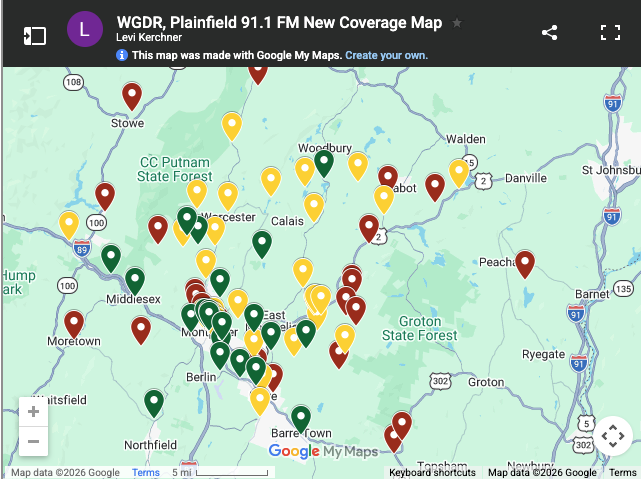
This is our working new broadcast map, as mapped by listeners. The yellow areas are where signal is a little less clear, red is fuzzy (most of those were not reached with the old antenna either). If you are in a yellow zone, you will likely have success by trying some of the tips above or switching to WGDH!